
Application period is now open!
All application materials MUST be submitted using the online portal.
Section I Grant Information
Background
The #1 recruitment challenge for employers, identified in the 2025 ND Workforce Ecosystem Assessment, is “not enough workers.” With the 3rd lowest unemployment rate across the country, but over 16,000 open jobs, North Dakota must look outside its borders to fill our workforce needs. People can learn about jobs without seeing them, but they cannot understand the lifestyle that North Dakota has to offer without seeing and feeling it. By hosting fly-in events across the state for qualified candidates identified from the Find The Good Life pipeline, we can capitalize on the inviting nature of North Dakota and showcase the good life people can have here while highlighting real career opportunities.
According to Lightcast’s 2025 Talent Attraction Scorecard, the #2 most important job factor is work/life balance. Not only will fly-in participants get the opportunity to meet with employers, but experience life in our communities. Based on Allied data, 31% of relocators said finding new housing was the most stressful part of the process, and for 26% the primary challenges were related to acclimating to their new communities. For 18%, it was finding new services, and for 17% it was making new friends. Visiting a community before moving gives people a chance to test daily comforts like commute times, neighborhoods, access to amenities, and social opportunities that simply don’t show up on a job contract or an online map. By integrating potential movers into our community for a weekend and connecting them with resources for housing, school districts, and more, we can decrease the unknowns and get candidates on their way to calling North Dakota home!
In 2023, a pilot Fly-in was conducted in Grand Forks with 7 participants. This event was used to create processes, identify challenges and solutions, create recommendations, and evaluate return on investment. To date, of the 7 that participated, 2 have relocated and brought an additional working adult, child, and teen, while 2 more are continuing to pursue moving to North Dakota with their family. The overall experience of this event helped identify the most desired information and activities that people are interested in experiencing and learning more about.
Based on initial success of the pilot program, the state will be funding up to 10 communities to conduct a Fly-In Event for a minimum of 5 potential movers plus a guest. Fly-In Events must include employer engagement in one to three of the applicant community’s major industries.
The goal of the program is to have successful conversions from fly-in participants to North Dakota residents. Consequently, successful awardees must commit to continued follow-up with fly-in events for up to a year post-event.
All events must occur by June 30, 2027. A community may only apply for one event at a time. Applicants can access up to $25,000 of matching grant funds for eligible expenses for each fly-in event. A minimum 1:1 match is required.
Purpose
The Talent Pipeline Fly-In Grant Program is designed to connect candidates with public and private sector employers who are hiring out-of-state job seekers while providing an experience of the “good life” in North Dakota.
The maximum amount of Fly-In funds an applicant can receive per funding round is $25,000. A one-to-one match is required. Funding will be open until all funds are obligated and spent.
Applications will be accepted beginning on March 24, 2026.
Eligible applicants include the following types of North Dakota-based organizations:
Economic Development Organizations
Cities (must be incorporated)
Counties
Chambers of Commerce
Job Development Authorities
Regional Councils
Tribal Entities equivalent to the organizations listed above
*State agencies are not eligible to apply
- Develop an itinerary for the event with partner collaboration.
- Accommodate minimum of 5 potential movers and any additional guests
- For every potential mover, a 21+ guest is allowed as a participant
- If participants are already identified by applicant, they must complete a Find the Good Life profile.
- If employer partners require assistance in identifying candidates to participate, they must partner with Commerce to promote the opportunity within the Find the Good Life pipeline.
- Secure welcome bags for participants to receive upon arrival, or something equivalent.
- Plan engaging group activities designed for program participants to learn about the culture, spirit, history, and life of your community.
- Secure all venues and arrange all necessary speakers/entertainment.
- Secure and provide tickets to any community activities or attractions planned for the event.
- Facilitate transportation from airport to hotel, to venues and activities around the community during the event
- Book lodging for each participant. The grant funds will cover state rate per diem expenses for lodging. If an applicant chooses a lodging option that exceeds the state rate, lodging expenses over and above per diem rate will be allowable as matching dollars.
- Example: Hotel state rate is $110 per night, per person. The hotel of choice for the event may exceed that- match can be used to cover the difference.
- Provide pre-arranged meals, food vouchers, or gift cards, for each meal for the duration of applicant's travel and tour days. The state will reimburse for per diem rates per meal. Any costs exceeding state per diem rates will be allowable as matching dollars.
- Example: Dinner per-diem is $22 but the applicant may choose to host a dinner that exceeds that amount and match may be used to cover the difference.
- Reimburse flights/mileage at current North Dakota Office of Management and Budget (OMB) expenditure policy indicates for participants traveling to community for event
- Cover any contracted services incurred to make sure that the program is accessible to all participants (ASL Interpreter, Accessibility Needs, Etc.)
- Ensure a staff member or project partner is present at all events for all days of the fly-in. The salary for this staff member is not an allowable grant expense.
- Provide a point of contact for participants during travel and community visit days for troubleshooting, directions, and guidance as needed.
- Post-event continued follow-up with potential movers for a period of one-year post event.
- Pre-event: Facilitate initial employer interviews with primary participants and optional guests that are also job seekers prior to fly-in event
- Based on our pilot Fly-In Event, we recommend planning for a Thursday arrival and Sunday departure
- Consider planning this during a time frame when there may be interesting events/signature community events
- Consider the employment needs of the primary participant’s guest
- Provide opportunities to meet with local property management and/or tour of available housing examples- in the pilot fly-in this was the second most important factor for participants
- Allow time for participants to meet with employers in-person during the event
- The event should include community tours, information or tours about housing, employer meet & greets and should include pre-arranged options for evening entertainment or community events.
- Sample itinerary from pilot event available here.
- Facilitate notification of the opportunity and link to apply to potential movers in Find The Good Life pipeline if additional candidates are needed and not previously identified by applicant or participating employers.
- Facilitate interviews and selection of participants for the Fly-In event alongside applicant representative if identified from Find the Good Life pipeline.
- Ensure candidate meets all requirements to be licensed and practice in North Dakota based on any occupational licensure requirements for the positions, as appropriate.
- Develop roster of participants for event to be shared with applicant and employer partners if participants have not been identified by the applicant partners.
- Develop and provide post-fly-in satisfaction survey
- Provide up to $25,000 in matching funds for eligible expenses for Fly-In events and activities outlined below:
- Flights for participants
- Food & lodging in accordance with State of ND policies (current state rate & per diem, excluding alcohol)
- Transportation costs (lowest bid obtained)
- Room or venue rentals to facilitate any activities on the itinerary
- Accessibility costs for participants that may require accommodations
Administration
The Talent Pipeline Fly-In Grant Program is administered by the Workforce Development Division of the Department of Commerce.
Applications must be submitted via the portal. Please note: Portal access requires up to three (3) working days for approval and must be requested with sufficient time to complete the application. Requests submitted too late to allow for approval will not extend the submission window.
For any questions related to the Talent Pipeline Fly-In Grant Program, please contact:
Sydney Helgeson
Talent Attraction Specialist
North Dakota Department of Commerce
701-328-7675
Section II Grant Proposals
All application materials MUST be submitted using the online portal. Please note: Portal access requires up to three (3) working days for approval and must be requested with sufficient time to complete the application before the deadline. Requests submitted too late to allow for approval will not extend the submission window.
Application period is now open!
Complete vendor registration with Office of Management and Budget to receive payment (if you have never received or have not received payment from the state within the past 12 months): Supplier Registration
Grant proposals must follow the format shown in Section II Part B, Proposal Format (below). Proposals that fail to meet the criteria set forth in Part B will not be rated and applicants will be required to resubmit using the proper format.
Complete proposals need to demonstrate a clear and concise explanation of the project, training, labor demand, and population served. The Department requires this section be used as a template for applications. Applications will only be received and accepted through the online portal.
IMPORTANT NOTE: Applicants must identify all sections of the proposal format to be considered for review.
Project Description
- What are your current efforts to attract and welcome newcomers?
- What are the workforce challenges facing this community and any identified contributing reasons and share any strategies being implemented to address them.
- What occupations and industries are you are currently targeting?
- Please provide labor or workforce data used to determine target industries and occupations.
- What resources or support systems are available to help newcomers integrate successfully?
- What activities or experiences will you provide during the fly-in to showcase your community?
- What are the strategies you plan to use to convert interested participants into actual movers?
Project Impact
- Identify the number of employers targeted for this event.
- Please list employer partners and relocation incentives currently offered.
- Identify the number of key industries targeted for this event.
- Identify the goal number of potential movers to participate in this event.
- Please list employer partners and relocation incentives currently offered.
Goals and Timeline
- What is the planned timeframe for event?
- Is there a specific community activity or event that the Fly-in opportunity is being planned in conjunction with?
Budget Proposal
The budget section must include a line-item budget and a narrative that explains the budget breakout and how funds will be used.
Eligible grant fund expenses:
- Airfare and/or mileage for potential movers
- Food and lodging in accordance with State of ND policies (current state rate and per diem, excludes alcohol) for the duration of the event.
- Room/venue rentals needed to facilitate activities on the itinerary
- Transportation costs (lowest bid obtained)
- Accessibility costs for participants that may require accommodations - if this expense is undetermined, it is recommended that 10% of the overall grant fund budget be allocated for accessibility related costs.
Ineligible grant fund expenses, but may be considered for match:
- Food and lodging costs that exceed the current state rate and per diem
- Transportation costs that exceed the lowest obtained bid
- Welcome bags and materials
- Tickets, entry fees, or costs associated with community activities
- Applicant administrative costs associated with planning and facilitating the event
- Note: This grant cannot supplant an existing budget.
Budget Narrative:
- Identify total project cost, grant funds requested, match obtained, match pending.
- A 1:1 or dollar for dollar match is required. Provide a description of the match (donations or discounts, in-kind activities, cash donations) and the private sector entities supplying the match.
- Describe how the match and match provider relate to the proposed community fly-in event.
- Explain any fund-leveraging and activities beyond match.
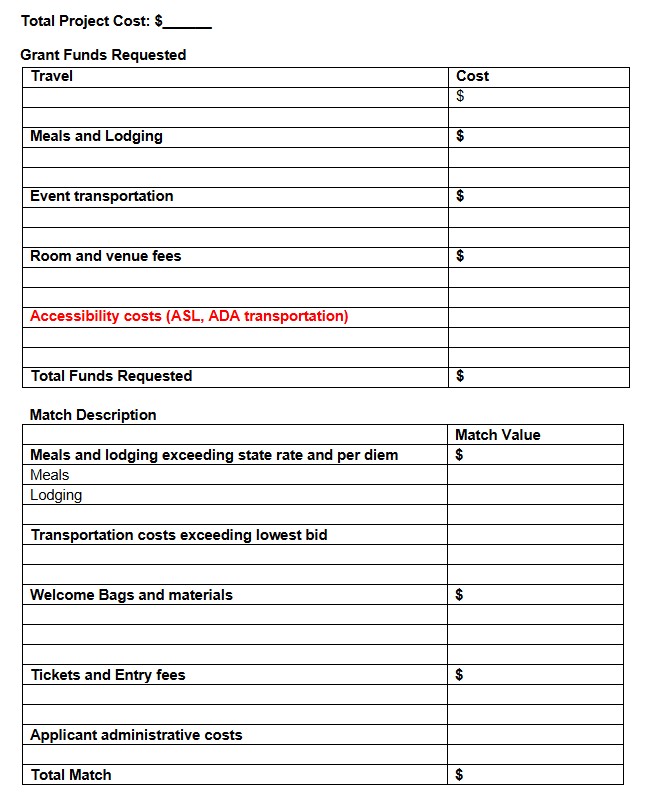
Budget Breakout:
The budget breakout will be formatted as shown below.
Supplemental Documentation:
- Sample itinerary plan
- Existing job descriptions/posting from employers
- Letters of support
- At least (3) three letters of support from employers that will participate in the fly in-event and additional letters from any organization that will provide match funding or in-kind. These letters must be uploaded at the time of application submission.
- Commitment of match
- View section IV B for match requirements
- Quotes or bids to support budget line items
Section III Proposal Review and Approval
A. Proposal Review and Rating
Application reviews will be completed by the Workforce Division of the North Dakota Department of Commerce. Applications will be reviewed in the order received. An applicant’s eligibility will be based on current efforts to attract and welcome new movers, demonstration of enhanced strategies, ability to secure employers participation and additional activities for fly-in, and match funds identified. Funding will then be obligated to the applicants that have met all guidance eligibility.
B. Application Timeline & Grant Approval
Application period is now open!
- Applications will be reviewed in the order received.
- Applicants will be notified of follow-up questions and clarification in approximately 3 weeks from received date.
- Notice of award will be issued in approximately 4 weeks from received date.
- Funds will be awarded until all program allocated funds are secured under a grant agreement.
The Division will notify the grantee of the award by contacting the respective applicant. The notification will include:
- Amount awarded.
- Request that the applicant name an authorized agent as the contact with the Division on the specific grant.
- Request that the GRANTEE contact the Department of Commerce prior to publicizing the award.
Section IV Grant Agreement
Grant Agreement Development
Upon approval of a grant proposal, the Division will develop a grant agreement. The Division will work with the authorized agent to finalize grant agreement details. The budget breakout section of the grant proposal will be inserted into the grant agreement under Section 3, Compensation.
General Match Requirements
- Expenses incurred that exceed allowable amounts outlined in Section 2B number 4 and/or in-kind (i.e., salary/fringe, donated services, venues, or supplies) may be used as match under the Fly-In Grant Program
- Match must be identified in the proposal. In some instances, match may not be fully obtained at the time the proposal is made. This is allowable, however in that instance, the grant award will be contingent upon submission and approval of match by the Division.
- Identified match expended prior to the award date will not be eligible.
- All match contributions must be properly valued by the donor and clearly identifiable from the grantee’s records and have adequate supporting documentation.
- Match should be from the private sector. Federal funds may qualify as match if the source of the funds allows. If using federal funds as match, applicant must specify the source and demonstrate that they can be used as match per funding source regulations.
- Match must be approved by the Division and must be directly related to the approved project.
- Project records must include documentation to demonstrate that match was used to support acquisition or provision of the approved grant project.
- All match used to support grant reimbursement must be used solely for this project during the grant agreement period.
- All cash match reported must be supported by documentation of the day the cash was received and the related accounting records that show the cash was used for the project.
- Cash match must be applied to the project and must be spent within the grant agreement dates of the project.
- Match from donation or discount must include documentation to support valuation of the donated/discounted item(s) at the time of use for the project. The match contributor must describe the item(s), state the value, and explain how the value was determined. The match contributor must sign and date the document containing this information. Note: If the match contributor is unwilling to provide this information, the requestor will contact the Division for assistance in determining an alternate method.
- Donations received prior to use for the project will not be eligible as match for this project.
- In-kind match is defined as temporary use of space or personal services. In-kind match can also include, but not limited to, salary/fringe and/or travel (mileage and lodging).
- Documentation of in-kind match must include a description of the process for determining the value of the services.
- If in-kind personal service is provided on a fixed contract amount, the documentation must include the services to be provided, the name of individual(s) providing the services and the time period in which the services are to be provided. A copy of the contract may be requested.
- If the in-kind personal service is provided based on an hourly amount, the documentation must include a description of the services provided, the name of individual(s) providing the in-kind personal services, the hourly rate for the service and a time sheet with an hourly log reflecting the time services were provided.
- In-kind space must be valued at market rate for the area. Documentation must include the methodology for determining the rate and proof of rates for the market.
IMPORTANT NOTE: Match contributions spent prior to the award date, are not eligible and will not be applied toward overall match for this grant.
Reporting Requirements
Performance Reporting
Performance reporting for the Fly-In Grant Program is required under the Common Accountability Measures established by the Division of Workforce Development in compliance with NDCC 54-60-19(2). GRANTEE will submit the performance data as required in Attachment II, Workforce Division Performance Accountability Reporting. GRANTEE will send separate notification of delivery (exclusive of data) to the Department of Commerce via the grant portal.
Progress Narrative
A mid-project Progress Narrative will be required one month after the project mid-point based on the timeline submitted.
The final report will be due within 15 days upon completion of awarded project or June 30, 2027, with the final disbursement request.
Final reporting must include response to requirements listed below. Final report narratives will be submitted via grant portal with final disbursement request as a supplement document.
- Number of job offers made and/or accepted as a result of the event
- Timeline of relocation and number of family members relocating
- Employer satisfaction with candidates available
- Applicant report of perceived successes, challenges, and unexpected outcomes
- Total costs of the fly-in event
- Based on your experience conducting a fly-in event, do you anticipate budgeting for this type of event in the future to offer to more employers and candidates?
The final report must include a complete line-item list of how grant and matching funds were used.
Commerce may request post-funding period updates related to movement of the participants and jobs filled for up to one year after the event. Updates after the award period will be submitted via email to helgeson.sydney@nd.gov.
Expenditure Report/Request for Funds
Fifty percent (50%) of funds are provided upon execution of the agreement, and 50% are provided upon acceptance of the final report, and all allowable funds and match have been extinguished. Documentation of expenses must be maintained by the applicant and made available upon request. Commencement of funding as outlined in the terms of the award.
NOTE: Failure to comply with the reporting requirements for the Grant may result in termination of the Grant.
Grant Agreement Modification
The GRANTEE will contact the Division to get prior approval on changes to match, authorized use of grant funds, grant agreement term, or funding. Approved requests may be denied if not appropriate to the grant or may require grant agreement modification prior to implementation. A line-item deviation from grant agreement budget of no more than 10% will be accepted without prior permission and will not require grant agreement modification. This deviation allowance does not include total grant agreement amount.
Grant agreement modifications should be completed during the grant agreement period.
Grant Agreement Closeout
Near the end of the grant agreement, the Division will notify the GRANTEE via email that the grant agreement has been closed. This notification signifies the end of the grant agreement and releases the administrator and the grantee from any further obligations under the grant agreement.
Section V Monitoring
The Division will monitor at least 50% of all grants during the grant term. Monitoring via desk review is allowable if documentation can satisfactorily support the review. Monitoring times will be targeted to allow the grantee to have submitted at least one request for funds. This gives the monitor and grantee an opportunity to review the process more completely.